Municipalities and local governments can easily track leave and attendance by centralizing time-off requests, accruals, approvals, worked hours, and attendance records. The right tool should accommodate different employee groups, seniority-based entitlements, departmental approval structures, and banked time—while keeping records consistent and simple to report on. PurelyHR brings these processes together in one smooth, unified system.
Why leave management is different in municipalities
Managing employee leave is rarely a one-policy process for municipalities. A municipality may have employees working across public works, administration, recreation, utilities, emergency services, and many other departments. Each one may have different schedules, responsibilities, and employment agreements.
Seniority:
Seniority is a great example. Vacation entitlements might increase as employees reach specific service milestones. HR needs a reliable way to apply the right accrual rules at the right moment. But calculating these changes manually can become increasingly challenging as your workforce expands and employees reach different points in their careers.
Union agreements:
Union agreements add another layer of complexity. Different bargaining units may have different rules for vacation, sick leave, holidays, overtime, or other forms of time off. Even within the same municipality, HR may need to manage several sets of rules simultaneously.
Banked overtime
Banked overtime can also be part of the picture. Employees may accumulate time off rather than receiving overtime pay immediately, particularly in areas such as public works, emergency services, or other operational roles. This creates yet another balance to track accurately and consistently.
Organizational structure
Organizational structure is also key. A municipality may have numerous departments, locations, managers, and approval paths. A request that belongs with one department manager may follow a completely different path from a request belonging to another.
Public accountability
Public accountability is another in-built characteristic that sets municipalities apart. Unlike many private-sector organizations, municipalities operate under a high level of public scrutiny. Leave and attendance records have to be accurate, consistent, and readily available when HR, finance, managers, employees, or auditors need to review them.
The common challenges—and the cost of getting it wrong
For municipalities, inefficient leave tracking can create a lot more than extra paperwork—it can lead to errors, disputes, and unnecessarily tedious work. Here are some of the most common challenges, and what's at stake when they're not addressed:
- Paper forms and spreadsheets spread across departments. When leave requests and balances are tracked in different spreadsheets, paper forms, or departmental systems, it can be difficult to know which information is current. Discrepancies take time to resolve and can leave HR without a clear, centralized record.
- Manual carryover and accrual calculations at year-end. Seniority-based entitlements, different employee policies, and varying renewal dates can make year-end calculations complicated. Manual calculations increase the risk of errors, potentially resulting in incorrect leave balances and additional work for HR to identify and correct them.
- Disputes over balances and entitlements without a clear record. When an employee questions a leave balance or entitlement, HR needs to be able to see what was requested, approved, accrued, or adjusted. Without a reliable record, resolving disputes can take more time and make it harder to establish what should have been applied.
- Administrative time lost chasing approvals. HR staff and administrators can spend significant time forwarding requests, following up with managers, answering balance questions, and correcting records. That time adds up, taking attention away from other HR and administrative priorities.
A digital leave management system does not eliminate the need for sound policies or human oversight. It can, however, reduce the manual work and risk involved in applying those policies consistently.
What municipalities should look for in a leave and time tracking tool?
Municipal HR teams should be on the lookout for software that can adapt to their policies rather than requiring organizations to change to fit the software. Here's what to look for:
- Custom leave types and policies: the system should allow HR to create leave categories that reflect the municipality's actual policies and employee agreements, rather than forcing every employee into the same structure.
- Seniority-based accruals: for organizations where vacation entitlements change with length of service, automated accrual rules can help ensure employees receive the appropriate entitlement without requiring HR to recalculate balances manually. PurelyHR, for instance, supports automated accruals and length-of-service policies.
- Department-based approval hierarchies: requests should be routed to the appropriate manager or approver based on the municipality's organizational structure. This keeps responsibility with the people who understand departmental staffing needs.
- Location-specific holiday calendars: different municipal locations or employee groups may observe different holidays or schedules. Your system should make it possible to manage those differences without maintaining separate manual calendars.
- Reports and audit trails: HR should be able to see balances, requests, approvals, and changes when needed. Reporting is particularly important when information needs to be shared with finance, payroll, managers, or other departments.
- Appropriate security: employee leave and attendance information is sensitive personnel data. Municipalities should evaluate the security practices and certifications of any software provider before entrusting it with employee records.

Why a standalone tool can fit when payroll is handled internally
Not every municipality needs—or wants—to replace its payroll system in order to modernize leave and attendance tracking.
In many municipalities and local governments, payroll is handled by an internal finance department, payroll team, or dedicated payroll system. If that system already meets the organization's payroll requirements, replacing it simply to improve leave management may introduce unnecessary hurdles.
A dedicated leave and attendance tool can instead peacefully coexist with your existing payroll process. HR and managers can manage requests, balances, approvals, worked hours, and attendance in one place, while payroll receives the information it needs.
This approach can be particularly useful for municipalities looking to modernize one part of their HR workflow without undertaking a full payroll migration.
How PurelyHR helps municipalities and local governments
PurelyHR is a modular HR platform, allowing organizations to use the tools that fit their needs rather than adopting a larger all-in-one system. Its Time-Off, Time-Clock, and Time-Sheet modules work together to manage different aspects of leave and time tracking.
Time-Off: provides the foundation for municipal leave management. HR teams can create custom time-off types, accrual rules, and length-of-service settings for seniority-based entitlements, along with approval hierarchies, restrictions, and per-location holiday calendars. A user audit trail and detailed reports provide visibility into requests, balances, and changes.
For municipalities managing banked overtime or travel hours, PurelyHR’s Banked Time function tracks accumulated time and can transfer banked hours into time-off balances. Employees can submit time-off requests digitally, while managers can review and approve them without relying on paper forms or email chains.
Time-Clock: supports clock-in and clock-out tracking, schedules, overtime rules, approval processes, and attendance reporting. Managers can get an at-a-glance view of who is in, out, late, sick, or on vacation, with reports that can be organized by department or employee.
Time-Sheet: offers simple, detailed, or advanced timesheet formats with approval paths for hourly and departmental staff, giving municipalities flexibility in how employees record and submit their time.
Trust: we take security seriously. PurelyHR is SOC 2 Type 2 and ISO 27001 certified, with municipalities already among our customers.
A simpler approach to municipal leave management
For municipalities, effective leave management is not simply about tracking vacation days. It means accurately applying seniority-based entitlements, accommodating different employee groups and agreements, managing banked time, routing approvals through the right departments, and maintaining reliable records.
The right system can take much of the repetitive calculation and record-keeping out of the process while preserving the flexibility municipalities need.
If your municipality is still relying on spreadsheets, paper forms, or disconnected processes to manage leave and attendance, PurelyHR offers a practical way of centralizing those workflows without requiring you to replace your existing payroll system.
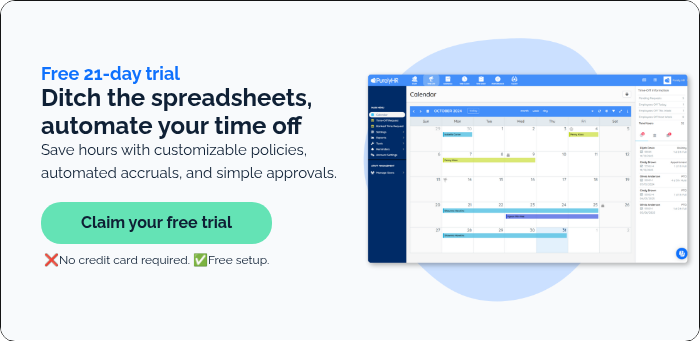
Ready to see how it could work for your municipality? Start a 21-day free trial of PurelyHR or book a demo to explore the platform with your team.
 ChatGPT
 Perplexity
 Gemini
 Claude
 Grok